

ISSN: 0973-7510
E-ISSN: 2581-690X
 , Manoj Kumar1 , Shanmugasundaram Nagarajan1, Chakradhar Tosh1, Harshad V. Murugkar1, K. Rajukumar1, Megha Sharma2, Shefali Udayakumar Tiwari1, Kumar Gaurav1,
Pushpendra Kumar Namdeo1
and Aniket Sanyal1Avian influenza (AI), especially H5Nx viruses of clade 2.3.4.4b gained global attention due to their rapid evolution and widespread circulation. The infection by this clade have been documented in mammals held in captivity and the wild, together with confirmed human cases, which suggest its expansion of host range. Using the guinea pig as an in vivo transmission model, this study examined the susceptibility, viral shedding, and in-contact transmission of H5N1 virus isolate (A/duck/India/11TR05/2021) belonging to clade 2.3.4.4b. Six guinea pigs (infection subgroup) were given an intranasal dose of 106 EID50, and another six naive guinea pigs (transmission subgroup) were co-housed 24 hours post-infection. Specimens from nasal washing have been taken up to 14 dpi to evaluate viral transmission and shedding. Every day, clinical symptoms were evaluated, while viral RNA in nasal washing samples and seroconversion were evaluated by RT-qPCR and hemagglutination inhibition assay, respectively. All animals (infection and transmission subgroup) remained clinically stable with no visible disease symptoms. All directly inoculated guinea pigs supported efficient replication of virus, with high viral RNA loads between 1 and 6 dpi. One contact animal had evidence of in-contact transmission, which showed progressive viral replication and seroconversion, while the remaining contact animals exhibited low-level or transient viral RNA detection without detectable antibody responses. This study reveals that the wild-type A/duck/India/11TR05/2021 H5N1 virus isolate belonging to clade 2.3.4.4b replicates efficiently in guinea pigs and has a limited transmission capacity to in-contact animals without prior mammalian adaptation. Continued molecular surveillance and experimental transmission studies are essential to detect early indicators of increased mammalian transmissibility and pandemic risk.
Highly Pathogenic Avian Influenza, In-contact Transmission, Mammalian Adaptation, Pandemic Risk, Viral Shedding
Clade 2.3.4.4b viruses belongs to H5Nx AI viruses are enveloped representatives of the family Orthomyxoviridae and possess a segmented genome having single strand, negative sense RNA.1 These eight genome segments encodes to ten or more viral proteins those are part of structural and non-structural proteins of helps in replication and virus assembly and interactions with host. Influenza A virus subtypes, such as H5N1, are defined by the antigenic characteristics of the two distinct glycoproteins on the surface present on the viral envelope: neuraminidase (NA) and hemagglutinin (HA).2 Influenza A viruses, particularly HPAI H5N1, have the potential to be zoonotic and pandemic, making them a serious threat to global public health.3-5
H5N1 viruses have diverged into various clades and subclades since its first detection in waterfowl from China during 1996. Among these clades 2.3.4.4b viruses have shown a remarkable potential to expand geographically and broaden its host range.6,7 Significant host-range expansion has been illustrated by 2.3.4.4b clade AI H5N1 virus, with cases documented in farmed minks, red foxes, tigers and leopards,8-11 sea mammals, viz. sea lions and elephant seals,12,13 pets including companion animals including dogs and domestic cats,14,15 and livestock like alpacas, goats, sheep, and dairy cattle.16-19 In addition to extensive outbreaks in birds, spillover incidents of H5N1 into different mammals has involved more than forty species extending across these continents America, Europe, and Asia, underscoring its expanding host range and zoonotic potential.7
Furthermore, this lineage and its progeny have shown frequent spillover into mammals, encompassing evidence consistent with transmission between mammals was reported among farmed mink populations in Europe (2022-2023),8 marine mammals which includes sea lions and elephant seals in across Antarctica and South America (since 2023),18,20,21 and sustained transmission also reported in the US dairy cattle (since 2024).19 As of February 2026, total 993 laboratory-confirmed human H5N1 infections reported worldwide since the first recorded human infection in 1997, which is significant because it has led to 477 deaths and an overall case mortality is around 48%.22 India reported HPAI H5N1 infections in different outbreaks since 2006 in domestic and wild avian populations, and also reported in non-avian hosts, including wild mammals (tigers and leopards), captive and domestic mammals (cats), and sporadic human cases, highlighting its zoonotic and inter-species transmission potential.23,24
Because guinea pigs are naturally prone for the infection to both (avian-origin and human) influenza, they serve as a suitable model for studies on influenza transmission. and recapitulate key aspects of human-like transmission.25,26 A primary limitation of the guinea pig in vivo experimental model for influenza studies is that infected animals typically lack distinct clinical symptoms of the illness.25 Previous literature have proved that certain H5N1 strains can transmit in guinea pigs under defined conditions, supporting their relevance for transmission risk assessment.25-27 Despite growing spillover events, the mammalian transmission potential of 2.3.4.4b clade of H5N1 remains poorly characterised. Therefore, this study evaluated the replication efficiency and transmission potential of a duck-origin 2.3.4.4b clade of H5N1 virus in the guinea pig biological model to better define its zoonotic risk and inform public health preparedness strategies.
Viral strain
H5N1 virus isolate (A/duck/India/11TR05/2021) which belongs to clade 2.3.4.4b, was obtained from the BSL-3 repository of Avian Influenza laboratory of the National Institute of High Security Animal Diseases (ICAR-NIHSAD), Bhopal (Madhya Pradesh), India. Specific pathogen-free (SPF) chicken embryos were used to amplify the virus according to standard virological techniques. In short, the allantoic cavity served as the site to inoculate in 9-1 day-old embryonated eggs under aseptic settings. After inoculation, the embryos were incubated for 72 hours at 37 °C for viral multiplication. The median embryo infective dose (EID50) of the passage of this strain was calculated using the Reed and Muench method.28 The sequences of total eight genes of the studied virus were submitted to the genetic sequence repository database of GenBank (NCBI), with accession numbers (PX930913-PX930920).
Ethical procedure for animal experimentation
The Institutional Animal Ethics Committee (IAEC) of ICAR-NIHSAD, Bhopal, which is accountable monitoring of ethical conduct in experimental animal research, provided its approval (Approval No. 136/IAEC/NIHSAD/23) for the study. To ensure that research work involving animals was done in compliance with established rules, the committee thoroughly examined the study design and methodology.
Experimental animals and study design
All infectious virus-related research work was conducted utilising the proper personal protective equipment in ICAR-NIHSAD’s BSL-3 and ABSL-3 containment facilities. Eighteen, three-month-old guinea pigs of the Hartley strain, weighing 300-350 g, were acquired from the Biological Products Division, College of Veterinary Science, Mhow, Madhya Pradesh, India. The guinea pigs were split into two groups at random: the control group (n = 06) and the H5N1 challenge group (n = 12), and maintained under negative-pressure isolators to prevent cross-contamination. Prior to experimentation, the guinea pigs were acclimatised for 2 days with free access to water and feed under a 12 hours dark/light cycle. H5N1 challenge group comprised of infection (direct inoculation) and transmission (in-contact) subgroups, 06 animals each. All six animals in the infection subgroup, were anaesthetised by a combination of ketamine at a dose of 30 mg/kg with xylazine @ 2 mg/kg followed by intranasal (I/N) inoculation of 100 µL of titrated wild-type A/duck/India/11TR05/2021 H5N1 virus (106 EID50). Hundred microlitres of sterile phosphate buffered saline (PBS) was administered via I/N route into the control group. Animals of transmission subgroup (in-contact animals) were introduced into the isolators of the infected subgroup 24 hours post-inoculation, to assess transmission under co-housing conditions (Table 1).
Table (1): Experimental grouping, inoculation, and co-housing design used to assess replication and transmission dynamics of duck-origin H5N1 avian influenza virus clade 2.3.4.4b in guinea pigs
Description |
No. of Guinea Pigs |
Inoculum (100 µL intranasal) |
Dose |
Contact Guinea Pigs Introduced/ co-housing |
|---|---|---|---|---|
Control group |
06 |
Sterile PBS |
– |
– |
H5N1 challenge group |
– |
Wild-type A/duck/India/11TR05/2021 (H5N1) |
106 EID50 |
– |
|
06 |
– |
– |
– |
|
06 |
– |
– |
at 24 hours post-inoculation of infected subgroup |
Total |
12 |
Monitoring and specimen collection
All the guinea pigs were monitored daily for clinical manifestations till 14 days post-contact. Nasal washing specimens from each animal were collected every day from day one of collection to 7 days post infection and every alternate day from 8-14 days. 1 mL of sterile PBS was instilled into the external nares using a sterile Pasteur pipette, and the nasal lavage specimen was collected in a sterile petri dish. Samples were transferred to 2 mL screw-cap tubes, aliquoted, and kept at -80 °C till further examination. Blood was drawn under anaesthesia at the conclusion of the trial, and sera were separated and kept at -20 °C for hemagglutination inhibition (HI) testing.
Viral RNA quantification
Viral RNA extraction from nasal wash specimens was done through QIAamp Viral RNA Mini Kit (Qiagen, Germany) in accordance with the manufacturer’s instructions. The Quant-iT™ RNA Assay Kit (Thermo Fisher Scientific, USA) and a Qubit® Fluorometer were used for subsequent RNA quantification. To create an RNA standard, a matrix clone was transcribed in vitro using the mMESSAGE mMACHINE™ T7 Transcription Kit (Thermo Fisher Scientific, USA). Viral RNA load in nasal wash samples was quantified by one-step RT-qPCR targeting the conserved influenza A matrix gene using the published primers.29 A molecular weight-based calculation by using RNA concentration, Avogadro’s constant, and amplicon length was used for calculation the RNA copy numbers for the in vitro transcribed standards. RNA copies number (molecules/µL) = (RNA concentration (grams/microliter) ÷ (amplicon length × 340)) × Avogadro’s number. Where 340 is taken in corresponding to single nucleotide’s mean molecular weight, Avogadro’s number is 6.022 × 10²³. The number of viral RNA copies was quantified from sample Ct values by using a standard curve created by ten-fold serial dilutions of matrix gene in vitro transcribed RNA.
Haemagglutination inhibition assay
Seroconversion in the H5N1 challenge group (directly inoculated and in-contact animals) was assessed by HI assay following WHO/FAO protocols.30 After 30 minutes of heat inactivation at 56 °C, serum specimen were serially diluted two-fold before being incubated with four homologous viral hemagglutinating (HA) units. The inverse of the highest dilution of serum that fully inhibited hemagglutination was considered as hemagglutination inhibition titer.
None of the guinea pigs from either the H5N1 challenge group or the control group presented with any clinical signs throughout the observation period. All six guinea pigs in the infection subgroup (direct inoculation) showed high viral RNA loads varied from 7.41 × 10⁷ to 4.68 × 10⁸ copies/mL through 1-6 dpi, with the peak viral load observed at 5 dpi (4.68 × 10⁸ copies/mL). Thereafter, viral RNA copies declined progressively to 9.12 × 10⁵ copies/mL at 7 dpi. By 9 dpi, viral RNA was quantified only in one animal at a low level (2.57 × 10⁵ copies/mL), and no viral RNA was detectable at 11, 13, and 14 dpi (Figure 1A). No viral RNA was detected in the guinea pigs of the control group.
In the transmission subgroup (in-contact animals), viral RNA in nasal wash specimens was detected at comparatively lower levels during the early time points at 1-2 dpc in three guinea pigs and at 3 dpc in two guinea pigs, with mean viral RNA loads ranging between 4.90 × 10⁵ to 3.63 × 10⁶ copies/mL. After 3 dpc, copy number in nasal wash specimen of viral genome was found in solely one guinea pig, with copy number load increasing to a peak 7.94 × 10⁸ copies/mL at 4 dpc. High viral loads were subsequently maintained at 5 and 6 dpc (5.13 × 10⁸ and 2.95 × 10⁸ copies/mL, respectively). Thereafter, viral RNA levels gradually declined to 3.89 × 10⁷ copies/mL at 7 dpc and 1.66 × 10⁵ copies/mL at 9 dpc. No viral RNA was detectable at later time points (Figure 1B). Mean copy number of viral RNA (copies/mL) for the control group, infection subgroup, and transmission subgroup are available in Table 2.
Table (2): The mean copy number of viral RNA (log10 copies/mL) in control group, infection and transmission subgroup
| Dpi/dpc | Log10 Mean copy number of viral RNA ± SEM | ||
|---|---|---|---|
| Control group | Infection subgroup (dpi) | Transmission subgroup (dpc) | |
| 1 | – | 7.92 ± 0.21 | 5.69 ± 0.35 |
| 2 | – | 8.58 ± 0.17 | 5.87 ± 0.55 |
| 3 | – | 8.45 ± 0.28 | 6.56 ± 1.16 |
| 4 | – | 7.87 ± 0.28 | 8.90 |
| 5 | – | 8.67 ± 0.18 | 8.71 |
| 6 | – | 8.49 ± 0.09 | 8.47 |
| 7 | – | 5.96 ± 0.31 | 7.59 |
| 9 | – | 5.41 | 5.22 |
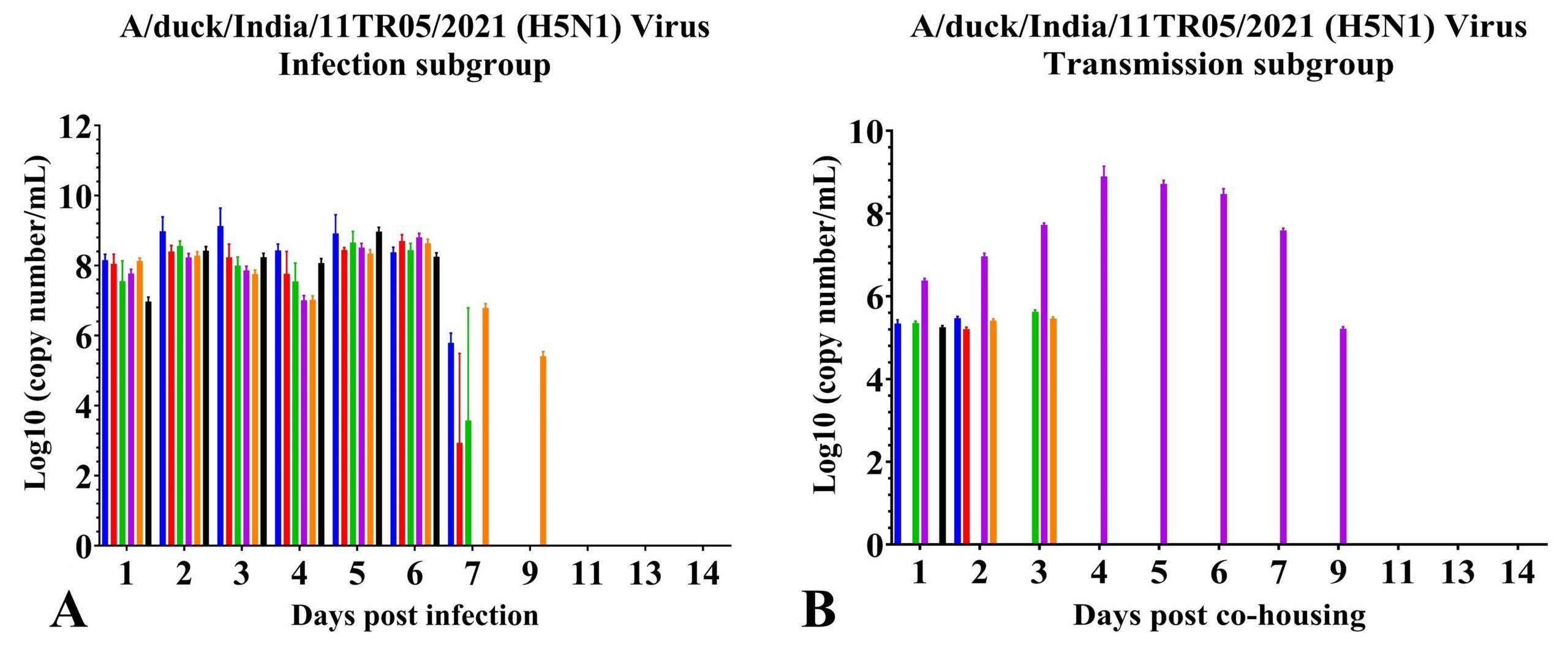
Figure 1. Viral RNA shedding and transmission of duck origin H5N1 A/duck/India/11TR05/2021 virus in guinea pigs. A. Viral RNA titers in nasal wash specimens of guinea pigs intranasally challenged with the H5N1 virus (infected subgroup). B. Viral RNA titers in guinea pigs co-housed with animals inoculated with the H5N1 virus (transmission subgroup). Each colored bar represents the copy number of viral RNA in nasal wash specimens from an individual animal on the indicated day post-infection (dpi) or post-co-housing (dpc)
Seroconversion was evaluated at the termination of the experiment (14 days post-infection) through HI assay. The animals of H5N1 challenge group, i.e., the infection subgroup showed 100% seropositivity (6/6), with a mean log2 HI titre of 4.67 ± 0.52. In the transmission subgroup (contact animals), one guinea pig (16.67%) seroconverted with log2 HI titre of 5 (Figure 2), while the remaining guinea pigs remained seronegative.
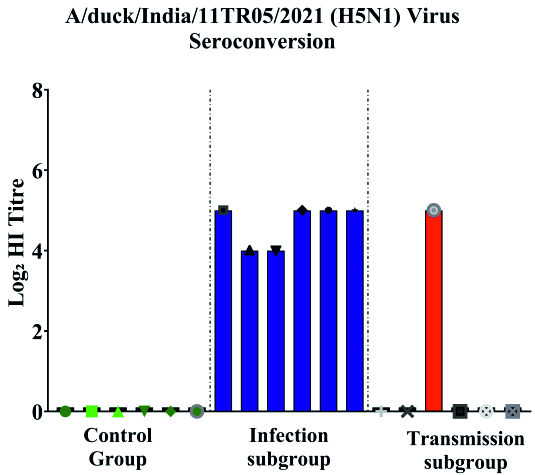
Figure 2. Seroconversion in inoculated guinea pigs and co-housed contact guinea pigs exposed to A/duck/India/11TR05/2021 (H5N1) virus. Individual haemagglutination inhibition (HI) antibody responses in the control group, infection and transmission subgroups
Clade 2.3.4.4b virus that belongs to the H5N1 viruses have become persistent global problem due to its devastating worldwide outbreaks in recent years. This clade has altered the epidemiological landscape of avian influenza by enhancing the pattern and infection ability of H5 viruses to affect other than avian species like mammals.8,14,31-33 Various documented spillover events into multiple mammalian species indicate a shift in host range.12,34-37 Such cross-species transmission events provide opportunities for viral adaptation within mammalian hosts, raising concerns about altered transmission dynamics and enhanced public health risk.35,38,39 Altogether, these findings highlight the dynamic character of H5N1 virus isolates from the 2.3.4.4b lineage and the necessity to keep a close watch on both bird and mammal species. In this study, we compared the replication, transmission, and serological responses induced by a duck origin H5N1 A/duck/India/11TR05/2021 virus in the guinea pig in vivo experimental model.
All of the guinea pigs in the current investigation exhibited no clinical symptoms during the study period, which is consistent result with earlier findings.25-27,40 The nature of innate immunity response mechanisms are considered to be contribute in conferring resistance to guinea pigs against HPAI viruses.30 They possess unique and highly efficient innate immune responses restrict viral replication to the respiratory passages of the upper airway and decrease the cytokine storm in guinea pigs which is responsible for the severe disease in other species.41 Following direct infection, the H5N1 virus showed robust viral replication in guinea pigs, with high copy number in nasal wash specimens detected early after inoculation and a gradual decline over time. These results outcomes corroborate with earlier findings indicating that avian H5N1 viruses can replicate efficiently in guinea pigs when delivered intranasally.25,26,40,42 Transmission of the H5N1 virus to co-housed naןve guinea pigs was sporadic and limited, with one contact animal showing evidence of progressive viral replication. The limited mammalian-to-mammalian transmission of unadapted avian H5N1 influenza viruses is primarily due to several major host-range barriers that prevent efficient infection and spread. These host limitations include limited replication in the upper respiratory passages, decreased polymerase efficiency, and suboptimal receptor use.43-45 In order to become more transmissible, H5N1 viruses need to overcome these barriers which typically requires specific molecular adaptations like PB2 mutations (increases polymerase activity in mammalian cells), HA receptor binding switch, loss of glycosylation (increase H5N1 binding to human-type receptors) etc.43-47 H5N1 virus induced robust seroconversion in directly infected animals, with 100% seropositivity and similar high HI titres were also observed in one in-contact animal of transmission groups which is in line with previous reports.48,49
According to the current investigation, after intranasal inoculation of the aforementioned clade of H5N1 virus (isolate A/duck/India/11TR05/2021) can replicate efficiently in the upper airways of guinea pig. Although transmission to naive in-contact guinea pigs was infrequent, the detection of viral replication and seroconversion in one in-contact guinea pig indicates inter-mammalian spread is not entirely precluded. Such low-level transmission events are biologically meaningful because it offers the possibility for incremental viral adaptation through repeated replication in a mammalian environment.50 Gradual accumulation of genetic changes, particularly in receptor binding and polymerase activity, such as HA, PB2, PA may enhance viral fitness in mammals.6,51,52 Even inefficient transmission can exert selective pressure favouring variants with improved replication in the upper passages of airways or enhanced transmissibility. Over time, and with continued exposure to mammalian hosts, these adaptations could increase the likelihood of sustained transmission.6,47 Therefore, limited transmission should not be interpreted as epidemiologically negligible but rather an early warning signal of partial mammalian adaptation.37 This underscores the importance of experimental transmission studies and monitoring of host-adapted variants, as incremental changes may precede the emergence of strains with enhanced zoonotic or pandemic potential.
This study shows effective replication with minimal inter-mammalian spread in guinea pig as in vivo transmission model, this study broadens our perspective about the potential of H5N1 viruses for zoonotic dissemination. These findings emphasise the importance of continuous molecular surveillance and experimental studies that focus on transmission to identify early indications of increased mammalian transmissibility and pandemic threat.
ACKNOWLEDGMENTS
The authors gratefully acknowledge the Director, ICAR–National Institute of High Security Animal Diseases (NIHSAD), Bhopal, and the Indian Council of Agricultural Research (ICAR), New Delhi, for providing financial support and necessary facilities under an institutional research project to carry out the present research work.
CONFLICT OF INTEREST
The authors declare that there is no conflict of interest.
AUTHORS’ CONTRIBUTION
All authors listed have made a substantial, direct and intellectual contribution to the work, and approved it for publication.
FUNDING
This work was supported by the Indian Council of Agricultural Research.
DATA AVAILABILITY
All datasets generated or analyzed during this study are included in the manuscript.
ETHICS STATEMENT
This study was approved by the Institutional Animal Ethics Committee, ICAR- National Institute of High Security Animal Diseases, Madhya Pradesh, India, vide approval no. 136/IAEC/NIHSAD/23.
- International Committee on Taxonomy of Viruses. Virus taxonomy: Orthomyxoviridae. ICTV Taxonomy Release 2024. 2024. https://ictv.global/taxonomy. Accessed February 28, 2026.
- Krammer F, Smith GJD, Fouchier RAM, et al. Influenza. Nat Rev Dis Primers. 2018;4(1):3.
Crossref - Charostad J, Rukerd MRZ, Mahmoudvand S, et al. A comprehensive review of highly pathogenic avian influenza (HPAI) H5N1: an imminent threat at doorstep. Travel Med Infect Dis. 2023;55(1):102638.
Crossref - Kandeil A, Patton C, Jones JC, et al. Rapid evolution of A(H5N1) influenza viruses after intercontinental spread to North America. Nat Commun. 2023;14(1):3082.
Crossref - O’Leary K. H5N1 from an infected dairy worker sheds light on viral transmission. Nat Med. 2024;30(11):2143-2144.
Crossref - Capelastegui F, Goldhill DH. H5N1 2.3.4.4b: a review of mammalian adaptations and risk of pandemic emergence. J Gen Virol. 2025;106(6):002109.
Crossref - Chrzastek K, Lieber CM, Plemper RK. H5N1 clade 2.3.4.4b: evolution, global spread, and host range expansion. Pathogens. 2025;14(9):929.
Crossref - Ag ero M, Monne I, Sanchez A, et al. Highly pathogenic avian influenza A(H5N1) virus infection in farmed minks, Spain, October 2022. Euro Surveill. 2023;28(3):2300001.
Crossref - Cronk BD, Caserta LC, Laverack M, et al. Infection and tissue distribution of highly pathogenic avian influenza A(H5N1) (clade 2.3.4.4b) in red fox kits (Vulpes vulpes). Emerg Microbes Infect. 2023;12(2):2249554.
Crossref - Amano M, Nga NT, Le Khanh Hang N, et al. Tiger deaths in Vietnam due to infection with H5N1 highly pathogenic avian influenza virus bearing mutations associated with mammalian host adaptation. Emerg Microbes Infect. 2025;14(1):2582252.
Crossref - Si YJ, Lee SH, Kim DJ, et al. First detection of clade 2.3.4.4b H5N1 highly pathogenic avian influenza virus in a wild leopard cat (Prionailurus bengalensis) in South Korea. Front Vet Sci. 2025;12(1):1638067.
Crossref - Uhart MM, Vanstreels RET, Nelson MI, et al. Epidemiological data of an influenza A/H5N1 outbreak in elephant seals in Argentina indicates mammal-to-mammal transmission. Nat Commun. 2024;15(1):9516.
Crossref - Plaza PI, Gamarra-Toledo V, Rodriguez Eugui J, Rosciano N, Lambertucci SA. Pacific and Atlantic sea lion mortality caused by highly pathogenic avian influenza A(H5N1) in South America. Travel Med Infect Dis. 2024;59(1):102712.
Crossref - Burrough ER, Magstadt DR, Petersen B, et al. Highly pathogenic avian influenza A(H5N1) clade 2.3.4.4b virus infection in domestic dairy cattle and cats, United States, 2024. Emerg Infect Dis. 2024;30(7):1335-1343.
Crossref - Moreno A, Bonfante F, Bortolami A, et al. Asymptomatic infection with clade 2.3.4.4b highly pathogenic avian influenza A(H5N1) in carnivore pets, Italy, April 2023. Euro Surveill. 2023;28(35):2300441.
Crossref - Lehman KA, Leibsle SR, Detwiler L, et al. Detection of highly pathogenic avian influenza A(H5N1) virus 2.3.4.4b in alpacas. J Vet Diagn Invest. 2026;38(2):145-150.
Crossref - Alkie TN, Embury-Hyatt C, Signore AV, et al. Dairy cow- and avian-origin clade 2.3.4.4b H5N1 induce severe mastitis in lactating goats and transmission to suckling goats. Cell Rep. 2025;44(10):116346.
Crossref - Banyard AC, Coombes H, Terrey J, et al. Detection of clade 2.3.4.4b H5N1 high pathogenicity avian influenza virus in a sheep in Great Britain, 2025. Emerg Microbes Infect. 2025;14(1):2547730.
Crossref - Sreenivasan CC, Li F, Wang D. Emerging threats of highly pathogenic avian influenza A(H5N1) in US dairy cattle: understanding cross-species transmission dynamics in mammalian hosts. Viruses. 2024;16(11):1703.
Crossref - Lisovski S, Gunther A, Dewar M, et al. Unexpected delayed incursion of highly pathogenic avian influenza H5N1 (clade 2.3.4.4b) into the Antarctic region. Influenza Other Respir Viruses. 2024;18(10):e70010.
Crossref - Gamarra-Toledo V, Plaza PI, Gutiérrez R, et al. Mass Mortality of Sea Lions Caused by Highly Pathogenic Avian Influenza A(H5N1) Virus. Emerg Infect Dis. 2023; 29(12):2553-2556.
Crossref - World Health Organization. Avian influenza weekly update #1032: 6 February 2026. Situation report. https://www.who.int/westernpacific/publications/m/item/avian-influenza-weekly-update—1032–6-february-2026. Accessed February 16, 2026.
- Food and Agriculture Organization of the United Nations, World Health Organization, World Organisation for Animal Health. Updated joint FAO/WHO/WOAH public health assessment of recent influenza A(H5) virus events in animals and people. April 17, 2025. Accessed February 16, 2026. https://www.woah.org/app/uploads/2025/04/2025-04-17-fao-woah-who-h5n1-assessment.pdf.
- Potdar V, Brijwal M, Lodha R, et al. Identification of human case of avian influenza A(H5N1) infection, India. Emerg Infect Dis. 2022;28(6):1269-1273.
Crossref - Lowen AC, Mubareka S, Tumpey TM, García-Sastre A, Palese P. The guinea pig as a transmission model for human influenza viruses. Proc Natl Acad Sci U S A. 2006;103(26):9988-9992.
Crossref - Bouvier NM, Lowen AC. Animal models for influenza virus pathogenesis and transmission. Viruses. 2010;2(8):1530-1565.
Crossref - Gao Y, Zhang Y, Shinya K, et al. Identification of amino acids in HA and PB2 critical for the transmission of H5N1 avian influenza viruses in a mammalian host. PLoS Pathog. 2009;5(12):e1000709.
Crossref - Reed LJ, Muench H. A simple method of estimating fifty per cent endpoints. Am J Epidemiol. 1938;27(3):493-497.
Crossref - Payungporn S, Chutinimitkul S, Chaisingh A, et al. Single step multiplex real-time RT-PCR for H5N1 influenza A virus detection. J Virol Methods. 2006;131(2):143-147.
Crossref - World Health Organization. Manual for the Laboratory Diagnosis and Virological Surveillance of Influenza. World Health Organization; 2011. Accessed February 20, 2026. https://www.who.int/publications/i/item/manual-for-the-laboratory-diagnosis-and-virological-surveillance-of-influenza.
- Bordes L, Vreman S, Heutink R, et al. Highly pathogenic avian influenza H5N1 virus infections in wild red foxes (Vulpes vulpes) show neurotropism and adaptive virus mutations. Microbiol Spectr. 2023;11(1):e02867-22.
Crossref - Uyeki TM, Milton S, Abdul Hamid C, et al. Highly pathogenic avian influenza A(H5N1) virus infection in a dairy farm worker. N Engl J Med. 2024;390(21):2028-2029.
Crossref - Pulit-Penaloza JA, Brock N, Belser JA, et al. Highly pathogenic avian influenza A(H5N1) virus of clade 2.3.4.4b isolated from a human case in Chile causes fatal disease and transmits between co-housed ferrets. Emerg Microbes Infect. 2024;13(1):2332667. Crossref
- Bellido-Martin B, Rijnink WF, Iervolino M, Kuiken T, Richard M, Fouchier RAM. Evolution, spread and impact of highly pathogenic H5 avian influenza A viruses. Nat Rev Microbiol. 2026;24(1):45-60.
Crossref - Pardo-Roa C, Nelson MI, Ariyama N, et al. Cross-species and mammal-to-mammal transmission of clade 2.3.4.4b highly pathogenic avian influenza A/H5N1 with PB2 adaptations. Nat Commun. 2025;16(1):2232.
Crossref - Larsen SV, Israelson R, Torp C, Larsen LE, Jensen HE, Kristensen C. Transmission, pathological and clinical manifestations of highly pathogenic avian influenza A virus in mammals with emphasis on H5N1 clade 2.3.4.4b. Viruses. 2025;17(12):1548.
Crossref - Peacock TP, Moncla L, Dudas G, et al. The global H5N1 influenza panzootic in mammals. Nature. 2025;637(8045):304-313.
Crossref - Koopmans MP, Behravesh CB, Cunningham AA, et al. The panzootic spread of highly pathogenic avian influenza H5N1 sublineage 2.3.4.4b: a critical appraisal of One Health preparedness and prevention. Lancet Infect Dis. 2024;24(12):e774-e781.
Crossref - Azeem RM, Yang YS, Sehrish S, et al. Emerging threats of H5N1 clade 2.3.4.4b: cross-species transmission, pathogenesis, and pandemic risk. Front Cell Infect Microbiol. 2025;15(1):1625665.
Crossref - Van Hoeven N, Belser JA, Szretter KJ, et al. Pathogenesis of 1918 pandemic and H5N1 influenza virus infections in a guinea pig model: antiviral potential of exogenous alpha interferon to reduce virus shedding. J Virol. 2009;83(7):2851-2861.
Crossref - Zhang K, Xu WW, Zhang Z, et al. The innate immunity of guinea pigs against highly pathogenic avian influenza virus infection. Oncotarget. 2017;8(18):30422-30437.
Crossref - Sun Y, Bi Y, Pu J, et al. Guinea pig model for evaluating the potential public health risk of swine and avian influenza viruses. PLoS One. 2010;5(11):e15537.
Crossref - Imai M, Herfst S, Sorrell EM, et al. Transmission of influenza A/H5N1 viruses in mammals. Virus Res. 2013;178(1):15-20.
Crossref - Manz B, Schwemmle M, Brunotte L. Adaptation of avian influenza A virus polymerase in mammals to overcome the host species barrier. J Virol. 2013;87(13):7200-7209.
Crossref - Zhao H, Zhou J, Jiang S, Bo-Jian Z. Receptor binding and transmission studies of H5N1 influenza virus in mammals. Emerg Microbes Infect. 2013;2(1):1-5.
Crossref - Kaplan BS, Webby RJ. The avian and mammalian host range of highly pathogenic avian H5N1 influenza. Virus Res. 2013;178(1):3-11.
Crossref - Bhojani MS, Bhojani MF. The emerging pandemic threat of H5N1: evolutionary adaptations for human transmission, zoonotic spillovers and surveillance gaps. Gene. 2025;967:149723.
Crossref - Rimmelzwaan GF, Katz JM. Immune responses to infection with H5N1 influenza virus. Virus Res. 2013;178(1):44-52.
Crossref - Palu G, Roggero PF, Calistri A. Could H5N1 bird flu virus be the cause of the next human pandemic? Front Microbiol. 2024;15:1477738.
Crossref - Nataraj R, Ashok AK, Dey AA, Kesavardhana S. Decoding non-human mammalian adaptive signatures of 2.3.4.4b H5N1 to assess its human adaptive potential. Microbiol Spectr. 2025;13(9):e00948-25.
Crossref - Griffin EF, Tompkins SM. Fitness determinants of influenza A viruses. Viruses. 2023;15(9):1959.
Crossref - Man W, Du L, Liu Y, et al. Evolution of H5N1 cross-species transmission: adaptive mutations driving avian-to-human infection. Adv Genet. 2026;7(1):e00051.
Crossref
© The Author(s) 2026. Open Access. This article is distributed under the terms of the Creative Commons Attribution 4.0 International License which permits unrestricted use, sharing, distribution, and reproduction in any medium, provided you give appropriate credit to the original author(s) and the source, provide a link to the Creative Commons license, and indicate if changes were made.