

ISSN: 0973-7510
E-ISSN: 2581-690X
 , B.X. Alimova , D.A. Amirsaidova, G.A. Bekmurodova, Sh.M. Miralimova, N.A. Elova, D.E. Saidova, O.M. Pulatova and M.A. Makhsumxanova
This study reports the characterization of Pediococcus acidilactici strain K1–UzRSMMT-396, a biosurfactant (BS)-producing lactic acid bacterium isolated from the traditional fermented milk product qurt. Primary screening of lactic acid bacteria isolates revealed a strain with pronounced surface-active properties, indicating its potential as a BS producer. Species identification was confirmed using morphological, biochemical, and molecular approaches, including MALDI-TOF MS and full-length 16S rRNA gene sequencing. The strain exhibited susceptibility to most of the tested antibiotics, including chloramphenicol, erythromycin, amikacin, cefotaxime, vancomycin, streptomycin, and amoxicillin/clavulanate, while showing moderate resistance to ciprofloxacin. P. acidilactici K1–UzRSMMT-396 demonstrated tolerance to simulated gastrointestinal conditions. After 90 min of exposure to simulated gastric juice (pH 2.0), viable cell counts remained at 5.1 ± 0.04 log CFU/mL, indicating the survival of a substantial fraction of the initial population. In the presence of bile salts, the strain maintained high viability, suggesting tolerance to conditions mimicking the small intestinal environment. In addition, the strain exhibited osmotolerance, retaining viability at elevated NaCl concentrations in MRS medium. Optimization of the cultivation medium showed that reducing cheese whey concentration from 50%-30% and halving the amounts of glucose, yeast autolysate, and ammonium citrate enhanced BS production. The emulsification index after 24 hrs of cultivation (EI24) reached 70%-74%, and the maximum BS yield was 2.704 g/L. The isolated biosurfactant exhibited pronounced antimicrobial activity against Pseudomonas aeruginosa, Escherichia coli, and Staphylococcus aureus, and effectively disrupted P. aeruginosa biofilms, resulting in a 59%-67% reduction in biofilm biomass depending on the test strain. These findings indicate that P. acidilactici strain K1–UzRSMMT-396 and its biosurfactant have strong potential for application in the food and pharmaceutical industries as safe antimicrobial and anti-adhesive agents.
Biosurfactant, Lactic Acid Bacteria, Pediococcus acidilactici, Medium Optimization, Antimicrobial Activity, Antibiofilm Effect
Surfactants are amphiphilic molecules composed of a hydrophilic (polar) head and a hydrophobic (nonpolar) tail. This structural organization enables their adsorption at interfaces such as liquid-air and liquid-liquid boundaries, resulting in a significant reduction of surface tension (ST) and interfacial tension (IFT). These properties enhance wetting, foaming, emulsification, and dispersion, making surfactants indispensable in numerous industrial sectors, including food processing, cosmetics, petrochemicals, and pharmaceuticals.
Despite their widespread use, chemically synthesized surfactants exhibit several critical drawbacks, including high production costs, reliance on toxic reagents, and poor biodegradability, which collectively raise serious environmental and health concerns.1,2
In response to these limitations, increasing attention has been directed toward environmentally friendly alternatives, particularly microbial biosurfactants (BS), which are synthesized by microorganisms as secondary metabolites. Compared to synthetic surfactants, biosurfactants offer multiple advantages, including biodegradability, low toxicity, environmental compatibility, and stability over a wide range of pH values and temperatures. Moreover, they display high surface and emulsifying activities. Importantly, biosurfactants often possess intrinsic antimicrobial, antifungal, and antiviral properties, broadening their potential applications in food technology, pharmaceuticals, medicine, cosmetology, and agriculture.3-5
When selecting microorganisms for biosurfactant production, especially for food and pharmaceutical applications, safety considerations are paramount. Candidate strains must be non-pathogenic and non-toxic to minimize potential health risks. Consequently, particular interest has focused on microorganisms with Generally Recognized as Safe (GRAS) status, notably lactic acid bacteria (LAB).6 LAB are widely used in food fermentation and probiotic formulations and are well known for their safety profile, making them attractive platforms for the development of safe and sustainable biosurfactants.7
Numerous studies have demonstrated the ability of LAB to produce biosurfactants with pronounced biological activity. However, comprehensive information on the chemical composition of LAB-derived biosurfactants remains limited. This gap is largely attributed to the structural diversity of these molecules and the technical challenges associated with their isolation and purification. Reported LAB biosurfactants include glycolipids, lipopeptides, glycolipoproteins, and complex protein–polysaccharide conjugates, with composition varying considerably among species and strains.8,9
Despite their promising functional properties, biosurfactants have not yet achieved competitiveness with chemically synthesized surfactants at an industrial scale. One of the primary constraints is the high cost of production. To overcome this limitation, the use of inexpensive and readily available substrates, such as agro-industrial residues and food industry by products, has been proposed as a key strategy.10 The utilization of such substrates can substantially reduce production costs and improve the economic feasibility of biosurfactant synthesis.
Accordingly, optimization of biosurfactant production should prioritize the selection of safe and efficient microbial producers capable of growth on low-cost media. This approach supports the development of sustainable and economically viable production processes that align with both industrial requirements and environmental safety standards.
In this context, the present study aims to characterize a biosurfactant-producing Pediococcus acidilactici strain K1–UzRSMMT-396, isolated from the traditional fermented dairy product qurt, and to evaluate its potential as a safe and efficient biosurfactant producer for pharmaceutical applications.
Bacterial strain and culture conditions
Pediococcus acidilactici strain K1–UzRSMMT-396 was isolated from the traditional fermented milk product qurt obtained under home fermentation conditions. The strain was routinely cultivated in de Man, Rogosa and Sharpe (MRS) broth (HiMedia, India) at 37 °C. For long-term storage, the strain was preserved at -80 °C in MRS broth supplemented with 10% (v/v) glycerol at the Laboratory of Microbiology and Biotechnology of Probiotics, Institute of Microbiology, Academy of Sciences of the Republic of Uzbekistan.
Morphological, cultural, and biochemical characterization
Cell morphology and Gram-staining characteristics were examined using Gram-stained vegetative cells under a light microscope at 1000× magnification (oil immersion). Cell motility was assessed by the hanging drop method.
Catalase activity was determined by bubble formation following exposure to 3% (v/v) hydrogen peroxide according to Harrigan and McCance. Hemolytic activity was evaluated on blood agar plates following CLSI and ISO 10993-5 guidelines. Gelatinase activity was assessed using gelatin-containing medium as described by MacFaddin. All tests were performed in triplicate.
Cultural characteristics were evaluated based on colony morphology and growth patterns on solid and liquid MRS media after incubation at 37 °C for 24-48 hrs.11
Carbohydrate fermentation profile
Carbohydrate utilization was assessed using differential carbohydrate fermentation tests based on Bergey’s Manual of Systematic Bacteriology. A modified MRS medium lacking glucose and meat extract was used as the basal medium. Individual carbohydrates (HiMedia, India) were added at a final concentration of 0.5% (w/v).
The following substrates were tested: Monosaccharides: glucose, arabinose, mannose, xylose, fructose, galactose, ribose Disaccharides: cellobiose, maltose, rhamnose, melibiose, sucrose, lactose Trisaccharides: raffinose, trehalose Sugar alcohols: salicin, sorbitol, mannitol.
Cultures were standardized to 0.5 McFarland units (≈1-1.5 × 10⁸ CFU/mL) and inoculated into test media. Fermentation was evaluated by color change of bromocresol purple indicator after 24 hrs, 48 hrs, 7 days, and 14 days of incubation at 37 °C.
Species identification by MALDI-TOF MS and 16S rRNA sequencing
Species-level identification was performed using MALDI-TOF MS by comparing protein mass spectra with a reference database.
Genomic DNA was extracted using a modified Marmur method
The full-length 16S rRNA gene was amplified using universal primers 27F
(5′-AGAGTTTGATCMTGGCTCAG-3′) and 1492R (5′-GGTTACCTTGTTACGACTT-3′). PCR amplification was carried out using Platinum™ HS PCR 2X Master Mix (Invitrogen, USA). Amplicons were purified and sequenced by the Sanger method. Sequence identity was confirmed via comparison with sequences deposited in the NCBI GenBank database.12,13
Growth measurement and biomass determination
Bacterial growth was monitored by measuring optical density at 540 nm using a spectrophotometer with a 1 cm path-length cuvette. For dry biomass determination, cultures were centrifuged at 10,000 × g for 10 min at 4 °C. The cell pellets were washed twice with sterile phosphate-buffered saline (PBS), dried to constant weight, and weighed using an analytical balance.14
Simulated gastrointestinal tolerance assay
Tolerance to simulated gastrointestinal conditions was evaluated according to established probiotic assessment protocols. Overnight cultures grown in MRS broth were harvested by centrifugation at 10,000 × g for 10 min at 4 °C, washed twice with sterile PBS, and resuspended to the original volume.
Simulated gastric juice consisted of 0.5% NaCl and 0.3% pepsin adjusted to pH 2.0. Simulated intestinal juice contained pancreatin (0.1 g) and ox bile (0.3 g) dissolved in 100 mL of 0.5% NaCl and adjusted to pH 8.0. All solutions were filter-sterilized (0.22 µm).
Aliquots of bacterial suspension were incubated with simulated gastric juice at 37 °C, and viable counts were determined after 0, 30, 60, and 90 min. For intestinal tolerance, incubation was carried out for up to 3 hrs. Survival (%) was calculated relative to initial viable counts determined prior to exposure.15
Bile salt tolerance
Bile tolerance was assessed using MRS broth supplemented with bovine bile at final concentrations of 0.2%, 0.3%, and 0.4% (w/v), following FAO/WHO probiotic evaluation guidelines. Overnight cultures (1% v/v inoculum) were incubated at 37 °C for 24 hrs. Viable cell counts were determined by serial dilution and plating. Growth in bile-free MRS broth served as the control.
NaCl tolerance
Salt tolerance was evaluated by cultivating the strain in MRS broth supplemented with NaCl at concentrations of 2%, 4%, and 6.5% (w/v). Cultures were incubated at 37 °C for 48 hrs, and viable counts were determined by plate counting. MRS broth without NaCl supplementation was used as a control.14
Antibiotic susceptibility testing
Antibiotic susceptibility was assessed using the disk diffusion method. The antibiotics tested included chloramphenicol, erythromycin, amikacin, cefotaxime, vancomycin, streptomycin, amoxicillin/clavulanate, ofloxacin, co-trimoxazole, and ciprofloxacin (HiMedia, India). Results were interpreted qualitatively, as recommended for lactic acid bacteria, and discussed in the context of EFSA guidelines.
Biosurfactant production and medium optimization
Biosurfactant production was carried out in 250 mL Erlenmeyer flasks containing 50 mL of production medium. Cultures were inoculated at 1%-2% (v/v) and incubated at 37 °C for 24 hrs with agitation at 120 rpm.
Medium optimization was performed by varying carbon and nitrogen sources, including cheese whey, glucose, yeast autolysate, peptone, and ammonium citrate. After cultivation, cultures were centrifuged at 4,500 rpm for 20 min at 4 °C to separate cells from the culture supernatant.
Determination of emulsification activity
The emulsification index after 24 hrs (EI24) was determined by mixing equal volumes of culture supernatant and hydrocarbon, followed by vortexing and incubation at room temperature. EI24 was calculated as the percentage ratio of the emulsified layer height to the total liquid height.16
Antimicrobial and antibiofilm activity
Antimicrobial activity of the biosurfactant was evaluated using the agar well diffusion method against Pseudomonas aeruginosa, Escherichia coli, and Staphylococcus aureus. Inhibition zones were measured after incubation at 37 °C for 24 hrs.
Antibiofilm activity was assessed against P. aeruginosa strains using a microtiter plate assay. Biofilm biomass reduction was quantified relative to untreated controls.17
Isolation and primary screening of biosurfactant-producing strain
A total of lactic acid bacteria isolates was obtained from the traditional fermented milk product qurt. Primary screening based on surface activity revealed one isolate exhibiting pronounced emulsification and surface-active properties. This isolate was selected for further characterization and designated as strain K1–UzRSMMT-396.
Morphological, cultural, and biochemical characteristics
Strain K1–UzRSMMT-396 consisted of Gram-positive, non-motile coccoid cells arranged predominantly in pairs and tetrads, characteristic of the genus Pediococcus. The strain was catalase-negative and did not exhibit hemolytic or gelatinase activity.
On MRS agar, colonies were circular, convex, smooth, and creamy-white in color after 24-48 hrs of incubation at 37 °C. Growth in liquid MRS medium resulted in uniform turbidity without pellicle formation (Figure 1).
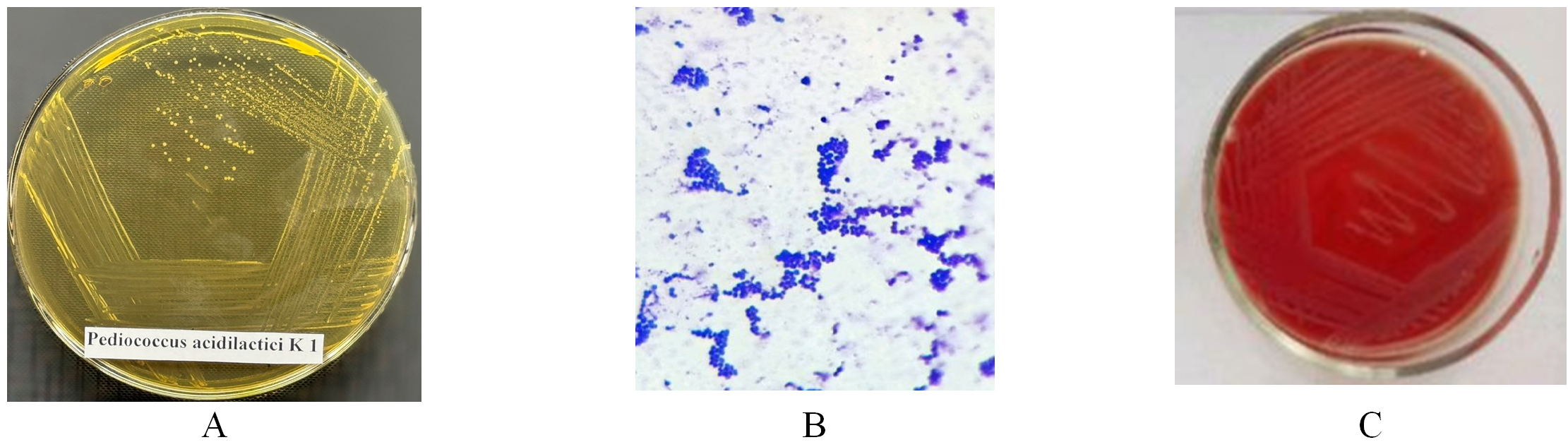
Figure 1. Morphological, biochemical and molecular characteristics of P. acidilactici strain K1–UzRSMMT-396. (A): Colony morphology; (B): Gram staining; (C): Hemolytic activity
Carbohydrate fermentation profile
The strain actively fermented glucose, fructose, galactose, mannose, lactose, sucrose, maltose, cellobiose, raffinose, and trehalose. Weak or delayed fermentation was observed for arabinose and ribose, whereas xylose, melibiose, sorbitol, and mannitol were not fermented. This fermentation pattern is consistent with previously described profiles of P. acidilactici.
Molecular and phylogenetic identification
The molecular identification of Pediococcus sp. isolate K1 was performed through full-length 16S rRNA gene sequencing. Comparative analysis revealed 99.9% sequence similarity with Pediococcus acidilactici reference strains, supporting its preliminary identification as P. acidilactici strain K1. Biochemical characterization, including sugar fermentation profiling, showed no deviations from the reference strain P. acidilactici ATCC 8042, indicating conserved fermentative pathways within this species.
Phylogenetic analysis was conducted using the Maximum Likelihood method with 1,000 bootstrap replications in MEGA-X version 11. The resulting tree placed strain K1 within a well-supported cluster of P. acidilactici species, distinct from closely related genera Lactiplantibacillus and Latilactobacillus (Figure 2).
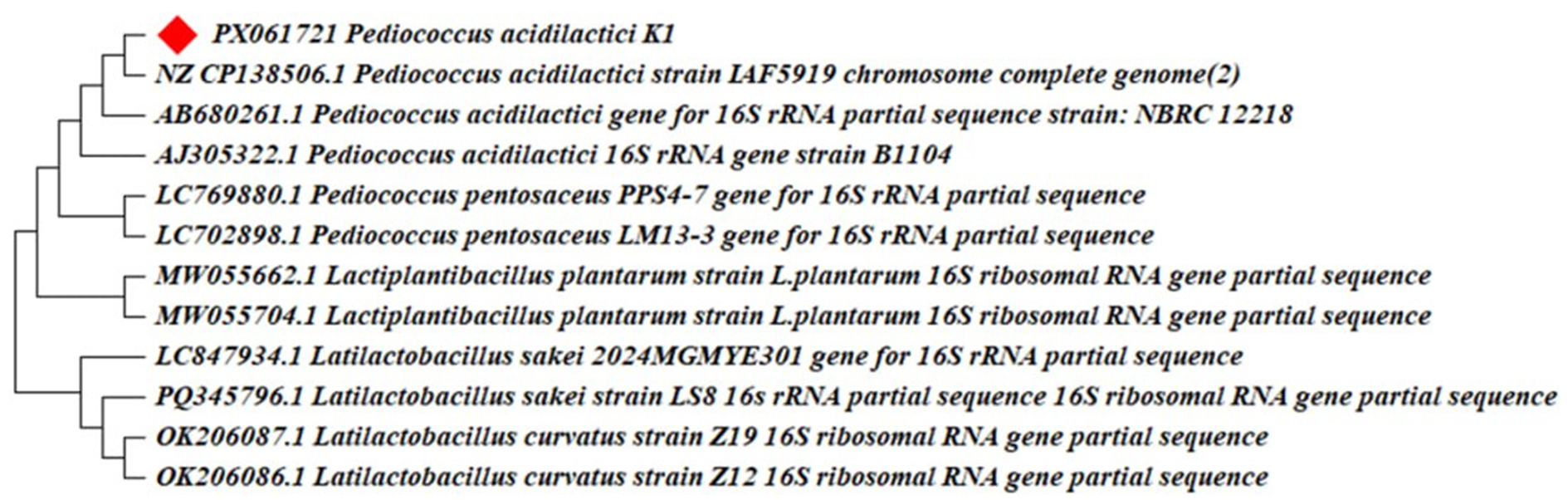
Figure 2. Phylogenetic tree of Pediococcus acidilactici strain K1 based on 16S rRNA gene sequences. The tree was generated using the Maximum Likelihood method (1,000 bootstrap replications) in MEGA-X v11. Strain K1 clusters with reference P. acidilactici strains and is clearly separated from related species in the genera Pediococcus, Lactiplantibacillus, and Latilactobacillus
The strain has been deposited in the National Center for Biotechnology Information (NCBI) database under accession number PQ757915 and is maintained in the culture collection of the Institute of Microbiology, Academy of Sciences of the Republic of Uzbekistan, under the designation P. acidilactici strain K1– UzRSMMT-396.
Antibiotic susceptibility
The antibiotic susceptibility of Pediococcus acidilactici K1–UzRSMMT-396 was evaluated using the disk diffusion method, following EFSA recommendations for lactic acid bacteria. The strain demonstrated a predominantly sensitive profile, with moderate resistance to ciprofloxacin and complete resistance to ofloxacin and co-trimoxazole (Table 1).
Table (1): Antibiotic susceptibility of Pediococcus acidilactici K1–UzRSMMT-396 measured by disk diffusion (diameter of inhibition zone, mm)
No. |
Antibiotic |
Disk content (mg) |
Inhibition zone (mm) |
Interpretation |
|---|---|---|---|---|
1 |
Ofloxacin |
5 |
0 |
R |
2 |
Chloramphenicol |
15 |
32 |
S |
3 |
Erythromycin |
15 |
32 |
S |
4 |
Amikacin |
30 |
25 |
S |
5 |
Cefotaxime |
30 |
26 |
S |
6 |
Vancomycin |
30 |
22 |
S |
7 |
Streptomycin |
10 |
20 |
S |
8 |
Ciprofloxacin |
3 |
12 |
SR |
9 |
Amoxiclav |
30 |
30 |
S |
10 |
Co-trimoxazole |
25 |
0 |
R |
The results indicate that the strain is highly sensitive to most clinically relevant antibiotics, including chloramphenicol, erythromycin, amikacin, cefotaxime, vancomycin, streptomycin, and amoxiclav, which supports its safety profile for potential applications in pharmaceutical and probiotic formulations. Partial resistance to ciprofloxacin and full resistance to ofloxacin and co-trimoxazole are consistent with previously reported intrinsic resistance patterns observed in lactic acid bacteria.18,19 Overall, these data confirm that P. acidilactici K1–UzRSMMT-396 is compatible with medical and food applications, posing minimal risk of horizontal transfer of antibiotic resistance.
Tolerance to simulated gastrointestinal conditions
The survival of P. acidilactici K1– UzRSMMT-396 was evaluated in simulated gastric fluid (SGF, pH 2.0, 0.3% pepsin) and simulated intestinal fluid (SIF, pH 8.0, 0.3% bile salts, 0.1% pancreatin). Viable counts were determined at defined time points, and survival (%) was calculated relative to the initial inoculum (~9.1 log CFU/mL) (Table 2).
Table (2): Survival in simulated gastric and intestinal fluids (log CFU/mL, mean ± SD, n = 3)
| Strain | SGF pH 2.0 | SIF pH 8.0 | ||||||
|---|---|---|---|---|---|---|---|---|
| 0 min | 30 min | 60 min | 90 min | 0 hr | 1 hr | 2 hrs | 3 hrs | |
| P. acidilactici K1– UzRSMMT-396 | 9.1 ± 0.02 | 7.3 ± 0.03 | 6.2 ± 0.02 | 5.1 ± 0.04 | 9.2 ± 0.02 | 9.4 ± 0.04 | 9.4 ± 0.03 | 9.3 ± 0.03 |
After 90 min exposure to SGF, viable counts decreased to 5.1 ± 0.04 log CFU/mL (~56% survival), indicating strong acid tolerance. In SIF, viability remained stable, confirming high resistance to bile salts and digestive enzymes.
Bile and salt tolerance
Resistance to bile and osmotic stress was assessed in MRS broth supplemented with 0.2%-0.6% bovine bile and 2%-6.5% NaCl. Viable counts remained stable (~9.1 log CFU/mL) across all concentrations tested (Table 3).
Table (3): Viability under different NaCl and bile concentrations (log CFU/mL, mean ± SD, n = 3)
Strain |
0 (control) |
2 |
4 |
6.5 |
0 (control) |
0.2 |
0.4 |
0.6 |
||
|---|---|---|---|---|---|---|---|---|---|---|
P. acidilactici K1–UzRSMMT-396 |
NaCl (%) |
9.1 ± 0.05 |
9.1 ± 0.04 |
9.1 ± 0.02 |
9.1 ± 0.04 |
Bile (%) |
9.1 ± 0.04 |
9.1 ± 0.03 |
9.1 ± 0.03 |
9.1 ± 0.02 |
Optimal cultivation conditions and biosurfactant production
The nutrient medium for P. acidilactici K1–UzRSMMT-396 was optimized by reducing whey from 50%-30% and halving the concentrations of glucose, yeast autolysate, and ammonium citrate. Under these conditions, both biomass growth and biosurfactant (BS) production were significantly enhanced. Biomass accumulation peaked within the first 36 hours of fermentation, with the most pronounced increase observed between 24 and 36 hours, correlating with the onset of BS synthesis.
Surface tension (ST) measurements reflected active BS production: ST decreased from 52.4 mN/m at 24 hours to a minimum of 41.3 mN/m at 36 hours, after which it stabilized (Figure 3). Simultaneously, the emulsification index (EI24) ranged from 70%-74%, confirming the efficient biosynthesis of surface-active compounds. These findings indicate that BS production by P. acidilactici K1–UzRSMMT-396 is tightly coupled with the exponential growth phase of the cells, consistent with previous observations in LAB-derived biosurfactants.20,21
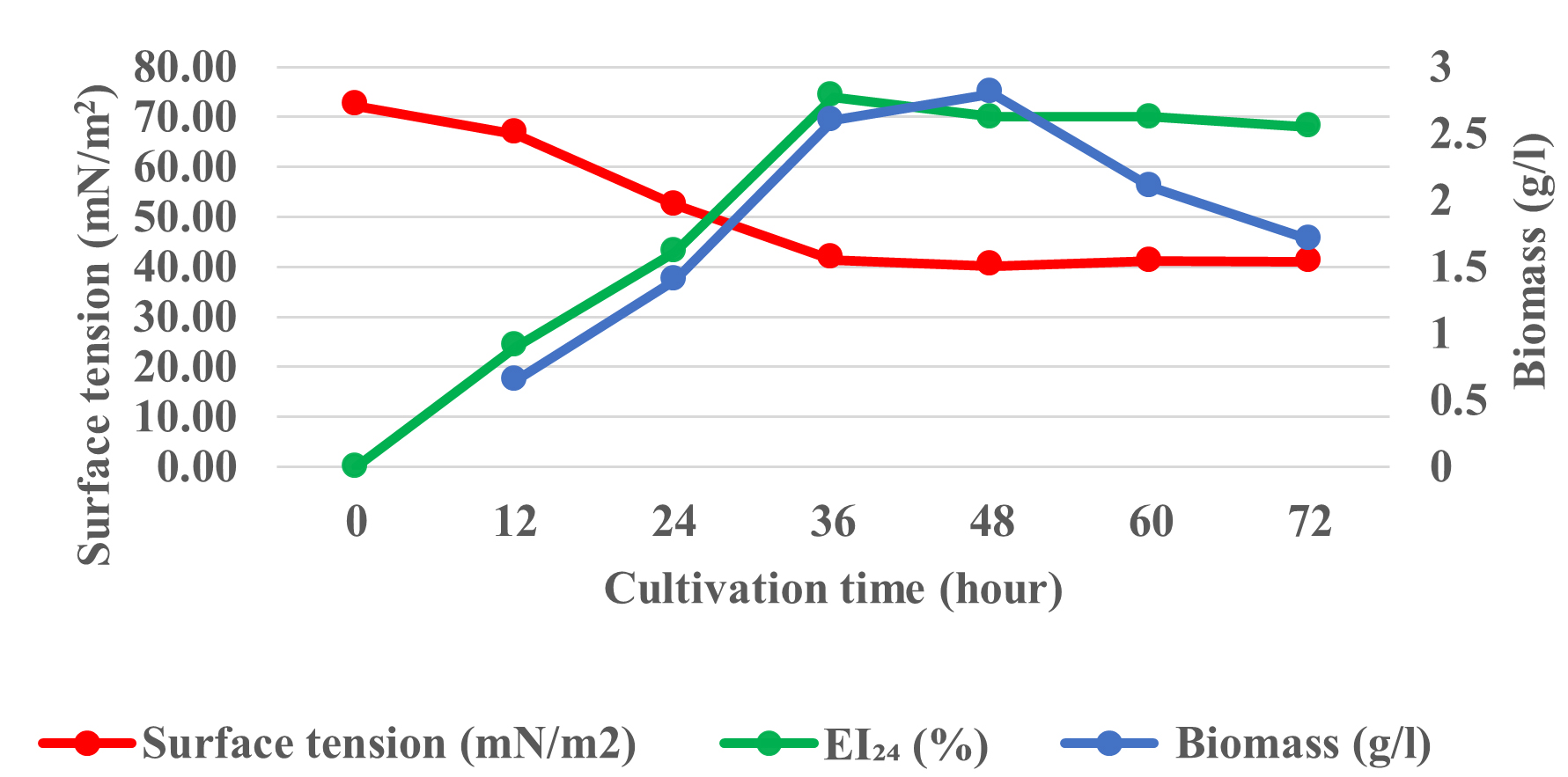
Figure 3. Dynamics of biomass growth and biosurfactant production by P. acidilactici K1–UzRSMMT-396, showing surface tension reduction over 36 hours of fermentation
BS extraction was performed using a combined approach of acid precipitation followed by organic solvent extraction. The strain produced 2.704 g/L of BS, a yield comparable to those reported for Pediococcus pentosaceus strains (1.2-4.51 g/L).20 The variability in yields across strains likely reflects differences in genetic background, cultivation parameters, nutrient composition, and extraction methods.
Preliminary chemical analysis suggests that the biosurfactant exhibits amphiphilic properties consistent with glycolipid- and lipopeptide-like compounds; however, comprehensive structural elucidation requires further spectroscopic analyses. This amphiphilic composition accounts for its surface tension-lowering, emulsifying, antimicrobial, and antibiofilm properties. Rapid BS accumulation within 36 hours offers significant technological advantages, including reduced energy consumption, lower equipment wear, and increased production efficiency, highlighting the strain’s potential for industrial-scale applications.
Antimicrobial activity of the biosurfactant
The biosurfactant (BS) produced by Pediococcus acidilactici K1–UzRSMMT-396 demonstrated pronounced antimicrobial activity against a range of test microorganisms. Biosurfactants derived from lactic acid bacteria are considered promising alternatives to conventional antibiotics due to their biodegradability, low toxicity, and reduced risk of resistance development. Their antimicrobial action is commonly attributed to the amphiphilic nature of BS molecules, which enables self-association and interaction with microbial cell membranes, leading to pore formation, membrane destabilization, and leakage of intracellular components. According to previous studies, biosurfactants produced by lactic acid bacteria exhibit broad-spectrum antimicrobial activity against bacteria and fungi.21,22
As shown in Table 4, the BS from P. acidilactici K1–UzRSMMT-396 exhibited strong inhibitory activity against P. aeruginosa, E. coli, and S. aureus, with inhibition zone diameters of 34, 30, and 34 mm, respectively. Moderate antimicrobial activity was observed against C. albicans and B. subtilis. These results are consistent with previous reports on LAB-derived biosurfactants.
Table (4): Antimicrobial activity of the biosurfactant produced by P. acidilactici K1–UzRSMMT-396
Test microorganism |
Inhibition zone diameter (mm)1 |
|---|---|
Pseudomonas aeruginosa 003841/114 |
34.0 ± 0.10 |
Escherichia coli 002673/477 |
30.0 ± 0.30 |
Candida albicans |
19.0 ± 0.50 |
Bacillus subtilis |
18.0 ± 0.10 |
Staphylococcus aureus 91 |
34.0 ± 0.20 |
1Values are expressed as mean ± SD (n = 3). Antimicrobial activity was evaluated using the agar well diffusion method
Antibiofilm activity
Biofilm formation is a major virulence factor of many pathogenic microorganisms, enabling persistence on both biotic (host tissues) and abiotic (medical devices and industrial surfaces) substrates. Microorganisms within biofilms exhibit increased tolerance to antimicrobial agents due to reduced permeability of the extracellular polymeric matrix, altered metabolic states, and activation of resistance-related genes. Consequently, infections associated with biofilms are often chronic, recurrent, and difficult to eradicate.23,24
Preliminary studies confirmed that Staphylococcus aureus, Pseudomonas aeruginosa, P. aeruginosa ATCC 9027, and S. aureus ATCC 25923 are capable of independent biofilm formation under model conditions,25 making them suitable test organisms for antibiofilm evaluation. The antibiofilm activity of the BS produced by P. acidilactici K1–UzRSMMT-396 was assessed at concentrations of 25% and 50%, using sodium dodecyl sulfate (SDS, 1%) as a positive control.
The results demonstrate that the unpurified BS from P. acidilactici K1–UzRSMMT-396 effectively disrupted biofilms formed by P. aeruginosa and P. aeruginosa ATCC 9027. Biofilm biomass reduction exceeded 50%, reaching 59% and 67% at a BS concentration of 50%, respectively. In contrast, no significant antibiofilm activity was detected against S. aureus and S. aureus ATCC 25923.
As shown in Table 5, antibiofilm activity exhibited a clear concentration-dependent pattern, with higher BS concentrations resulting in greater biofilm disruption for susceptible strains. The selective activity against P. aeruginosa suggests that the biosurfactant may preferentially interfere with biofilm matrix components or cell surface interactions characteristic of Gram-negative bacteria, highlighting its potential as a natural anti-adhesive and antibiofilm agent.
Table (5): Disruption of pre-formed biofilms by the biosurfactant produced by P. acidilactici K1–UzRSMMT-396
| No. | Strain | SDS concentration (%) | BS concentration (%) | |
|---|---|---|---|---|
| 1 | 1* | 2** | ||
| 1 | S. aureus ATCC 25923 | 88 | 4 | 1 |
| 2 | S. aureus | 79 | – | – |
| 3 | P. aeruginosa | 72 | 59 | 23 |
| 4 | P. aeruginosa ATCC 9027 | 81 | 67 | 57 |
1*: Concentration BS 50%; 2**: Concentration BS 25%
Lactic acid bacteria (LAB) are increasingly regarded as safe microbial platforms for the production of functional metabolites, including biosurfactants (BS), owing to their long history of use in food fermentation and their Generally Recognized as Safe (GRAS) status. However, in contrast to well-studied BS producers such as Pseudomonas and Bacillus, LAB-derived biosurfactants remain insufficiently explored, primarily due to their comparatively lower yields and the scarcity of comprehensive functional and safety assessments. The present study addresses this gap by providing an integrated phenotypic, physiological, and functional characterization of a BS-producing Pediococcus acidilactici strain isolated from a traditional fermented dairy product.1-5,23
The taxonomic identity of strain K1–UzRSMMT-396 was robustly established using a polyphasic approach combining classical phenotypic characterization, MALDI-TOF MS profiling, and full-length 16S rRNA gene sequencing. The near-complete sequence identity (99.9%) with reference P. acidilactici strains, together with a conserved carbohydrate fermentation profile, confirms the strain’s placement within this species. Importantly, the absence of hemolytic and gelatinase activities supports its biosafety, fulfilling essential criteria for food-grade and pharmaceutical applications. This aspect is particularly relevant, as strain-dependent safety differences have been reported even within LAB species, necessitating case-by-case evaluation.
Survival under gastrointestinal stress conditions is a critical prerequisite for the use of LAB and their metabolites in oral and functional formulations.26 Strain K1–UzRSMMT-396 exhibited pronounced tolerance to simulated gastric conditions (pH 2.0), retaining more than half of the initial viable population after 90 min of exposure, and maintained stable viability in simulated intestinal fluid containing bile salts and pancreatin. These survival rates are comparable to, or exceed, those reported for other BS-producing LAB, suggesting the presence of effective acid- and bile-resistance mechanisms. While in vitro gastrointestinal models cannot fully recapitulate the complexity of the human digestive tract, the observed robustness indicates favorable physiological adaptability of the strain.
The antibiotic susceptibility profile further strengthens the safety assessment of P. acidilactici K1–UzRSMMT-396. The strain was susceptible to the majority of clinically relevant antibiotics, including β-lactams, macrolides, and aminoglycosides. Reduced susceptibility to fluoroquinolones was observed, which is consistent with intrinsic resistance patterns commonly reported for LAB and is generally considered non-transferable. Nevertheless, the reliance on disk diffusion assays represents a methodological limitation, and future studies should incorporate minimum inhibitory concentration (MIC) testing and genome-based screening to definitively exclude the presence of acquired resistance determinants.
A key outcome of this study is the successful enhancement of BS production through medium optimization using cheese whey as a low-cost substrate. The achieved BS yield of 2.704 g/L and emulsification index (EI24 up to 74%) are comparatively high for LAB-derived biosurfactants and fall within, or exceed, the upper range reported for Pediococcus species. These results underscore the importance of substrate selection and nutrient balance in overcoming one of the major bottlenecks associated with LAB-based BS production namely, low productivity and high production costs. The use of agro-industrial by-products aligns with current trends in sustainable and circular bioprocessing and significantly improves the economic feasibility of BS production.
Functionally, the biosurfactant produced by P. acidilactici K1–UzRSMMT-396 exhibited pronounced antimicrobial activity against both Gram-negative and Gram-positive bacteria, confirming its broad-spectrum potential. Of particular interest is its antibiofilm activity against Pseudomonas aeruginosa, a clinically relevant opportunistic pathogen notorious for biofilm-associated infections and intrinsic antibiotic resistance. The BS effectively disrupted pre-formed P. aeruginosa biofilms, achieving biomass reductions of up to 67%, whereas little to no antibiofilm effect was observed against Staphylococcus aureus. This selective activity suggests that the BS may preferentially target structural or physicochemical features specific to Gram-negative biofilms, such as lipopolysaccharide-rich outer membranes or distinct extracellular polymeric matrix components.
Previous studies have proposed that LAB-derived biosurfactants, particularly glycolipid-like molecules, exert antibiofilm effects by reducing surface hydrophobicity, destabilizing extracellular polymeric substances, and interfering with initial adhesion processes.17,27 While the present study provides clear functional evidence for antibiofilm activity, the precise molecular mechanisms remain unresolved. Comprehensive structural elucidation using advanced analytical techniques, including NMR spectroscopy and high-resolution mass spectrometry, will be essential to establish structure function relationships and to rationalize the observed selectivity.
Several limitations of the present work should be acknowledged. The chemical characterization of the biosurfactant remains preliminary, and biological activities were assessed exclusively under in vitro conditions. Consequently, in vivo studies and toxicity evaluations are required to confirm safety and efficacy in real-world applications. Despite these limitations, the integrated assessment presented here encompassing safety, stress tolerance, production optimization, and functional activity provides a solid foundation for future translational research.
In summary, P. acidilactici K1–UzRSMMT-396 represents a promising LAB-based biosurfactant producer combining GRAS-associated safety, physiological robustness, efficient production on low-cost substrates, and selective antimicrobial and antibiofilm activities. These characteristics position this strain as a viable candidate for further development in food, pharmaceutical, and biomedical applications, particularly where safe and sustainable anti-adhesive agents are required.
Pediococcus acidilactici K1–UzRSMMT-396 is a biologically and technologically safe biosurfactant-producing strain, as demonstrated by the absence of hemolytic and gelatinase activities, high survival under simulated gastrointestinal stress, and susceptibility to the majority of clinically relevant antibiotics. These combined traits support its suitability for direct use in food-related and pharmaceutical biotechnological processes without additional biosafety constraints. Medium optimization using cheese whey as a low-cost substrate enabled an industrially relevant biosurfactant yield of 2.704 g/L with a high emulsification index (EI24 up to 74%) within a short fermentation time (≤36 hrs). This performance places the strain at the upper range reported for LAB-derived biosurfactants and directly addresses the major limitation of lactic acid bacteria, namely, low biosurfactant productivity. The biosurfactant produced by strain K1–UzRSMMT-396 exhibits strong and selective antibiofilm activity against Pseudomonas aeruginosa, disrupting more than 60% of pre-formed biofilms, while showing no comparable effect against Staphylococcus aureus. This selectivity indicates a specific interaction with Gram-negative biofilm structures and positions the biosurfactant as a functional anti-adhesive agent for biomedical and pharmaceutical applications targeting biofilm-associated contamination and infection.
ACKNOWLEDGMENTS
The authors thank the Institute of Microbiology, Academy of Sciences of the Republic of Uzbekistan, for providing laboratory facilities.
CONFLICT OF INTEREST
The authors declare that there is no conflict of interest.
AUTHORS’ CONTRIBUTION
All authors listed have made a substantial, direct and intellectual contribution to the work, and approved it for publication.
FUNDING
None.
DATA AVAILABILITY
All datasets generated or analyzed during this study are included in the manuscript.
ETHICS STATEMENT
Not applicable.
- Ghosh S, Ray A, Pramanik N. Self-assembly of surfactants: An overview on general aspects of amphiphiles. Biophys Chem. 2020;265:106429.
Crossref - Frinhani Nunes R, Teixeira ACSC. An overview on surfactants as pollutants of concern: Occurrence, impacts and persulfate-based remediation technologies. Chemosphere. 2022;300:134507.
Crossref - Jahan R, Bodratti AM, Tsianou M, Alexandridis P. Biosurfactants, natural alternatives to synthetic surfactants: Physicochemical properties and applications. Adv Colloid Interface Sci. 2020;275:102061.
Crossref - Markam SS, Raj A, Kumar A, Khan ML. Microbial biosurfactants: Green alternatives and sustainable solution for augmenting pesticide remediation and management of organic waste. Curr Res Microb Sci. 2024;7:100266.
Crossref - Karnwal A, Shrivastava S, Al-Tawaha ARMS, et al. Microbial biosurfactant as an alternate to chemical surfactants for application in cosmetics industries in personal and skin care products: A critical review. BioMed Res Int. 2023;2023:2375223.
Crossref - Mouafo HT, Sokamte AT, Mbawala A, Ndjouenkeu R, Devappa S. Biosurfactants from lactic acid bacteria: A critical review on production, extraction, structural characterization and food application. Food Biosci. 2022;46:101598.
Crossref - Ayivi RD, Gyawali R, Krastanov A, et al. Lactic acid bacteria: Food safety and human health applications. Dairy. 2020;1(3):202-232.
Crossref - Dini S, Bekhit AE-DA, Roohinejad S, Vale JM, Agyei D. The physicochemical and functional properties of biosurfactants: A review. Molecules. 2024;29(11):2544.
Crossref - Satpute SK, Kulkarni GR, Banpurkar AG, et al. Biosurfactant/s from Lactobacilli species: Properties, challenges and potential biomedical applications. J Basic Microbiol. 2016;56(11):1140-1158.
Crossref - Qamar SA, Pacifico S. Cleaner production of biosurfactants via bio-waste valorization: A comprehensive review of characteristics, challenges, and opportunities in bio-sector applications. J Environ Chem Eng. 2023;11(6):111555.
Crossref - Bergey’s Manual of Systematic Bacteriology. Baltimore: Williams & Wilkins. 2009;3:1317.
- Salva-Serra F, Gomila M, Svensson-Stadler L, et al. Culture collection University of Gothenburg (CCUG): A protocol for extraction and purification of high-quality and quantity bacterial DNA applicable for genome sequencing: A modified version of the Marmur procedure. Method in Protocol Exchange. 2018.
Crossref - Lane DJ. 16S/23S rRNA sequencing. In E. Stackebrandt, M. Goodfellow, Eds. Nucleic acid techniques in bacterial systematics. John Wiley and Sons, New York. 1991:115-176.
- Egorov NS. Practical training in microbiology. Moscow University Publishing. 1976
- Call EK, Goh YJ, Selle K, Klaenhammer TR, O’Flaherty S. Sortase-deficient lactobacilli: Effect on immunomodulation and gut retention. Microbiology. 2015;161(Pt 2):311–321.
Crossref - Cooper DG, Goldenberg BG. Surface-Active Agents from Two Bacillus Species. Applied and Environmental Microbiology. 1987; 53:224-229.
- Patel M, Siddiqui AJ, Hamadou WS, et al. Inhibition of bacterial adhesion and antibiofilm activities of a glycolipid biosurfactant from Lactobacillus rhamnosus with its physicochemical and functional properties. Antibiotics. 2021;10(12):1546.
Crossref - Anisimova EA, Yarullina DR. Antibiotic Resistance of Lactobacillus Strains. Curr Microbiol. 2019;76(12):1407-1416.
Crossref - Dec M, Nowaczek A, Stepien-Pysniak D, Wawrzykowski J, Urban-Chmiel R. Identification and antibiotic susceptibility of Lactobacilli isolated from turkeys. BMC Microbiol. 2018;18(1):168.
Crossref - Ghasemi A, Moosavi-Nasab M, Setoodeh P, Mesbahi G, Yousefi G. Biosurfactant Production by Lactic Acid Bacterium Pediococcus dextrinicus SHU1593 Grown on Different Carbon Sources: Strain Screening Followed by Product Characterization. Sci Rep. 2019;9(1):5287.
Crossref - Luong AD, Moorthy M, Luong JH. Microbial Biosurfactants: Antimicrobial Agents Against Pathogens. Macromol. 2026;6(1):6.
Crossref - De Giani A, Zampolli J, Di Gennaro P. Recent Trends on Biosurfactants With Antimicrobial Activity Produced by Bacteria Associated With Human Health: Different Perspectives on Their Properties, Challenges, and Potential Applications. Front Microbiol. 2021;12:655150.
Crossref - Wang X, Chen C, Hu J, Liu C, Ning Y, Lu F. Current strategies for monitoring and controlling bacterial biofilm formation on medical surfaces. Ecotoxicol Environ Saf. 2024;282:116709.
Crossref - Sharma S, Mohler J, Mahajan SD, Schwartz SA, Bruggemann L, Aalinkeel R. Microbial Biofilm: A Review on Formation, Infection, Antibiotic Resistance, Control Measures, and Innovative Treatment. Microorganisms. 2023;11(6):1614.
Crossref - Dildora AA, Gullola AB, Nilufar AE, Mastura AX, Shakhlo MM. Cell surface properties and biofilm formation ability of lactic acid bacteria from the oral cavity. Adv Biores. 2024;15(5):195-206.
Crossref - Stasiak-Rozanska L, Berthold-Pluta A, Pluta AS, Dasiewicz K, Garbowska M. Effect of Simulated Gastrointestinal Tract Conditions on Survivability of Probiotic Bacteria Present in Commercial Preparations. Int J Environ Res Public Health. 2021;18(3):1108.
Crossref - Datta D, Bhattacharjee S. Biosurfactants as novel antibiofilm agents: mechanisms, biomedical applications, and applications in biofilm-associated infections. Arch Microbiol. 2025;208(1):6.
Crossref
© The Author(s) 2026. Open Access. This article is distributed under the terms of the Creative Commons Attribution 4.0 International License which permits unrestricted use, sharing, distribution, and reproduction in any medium, provided you give appropriate credit to the original author(s) and the source, provide a link to the Creative Commons license, and indicate if changes were made.